

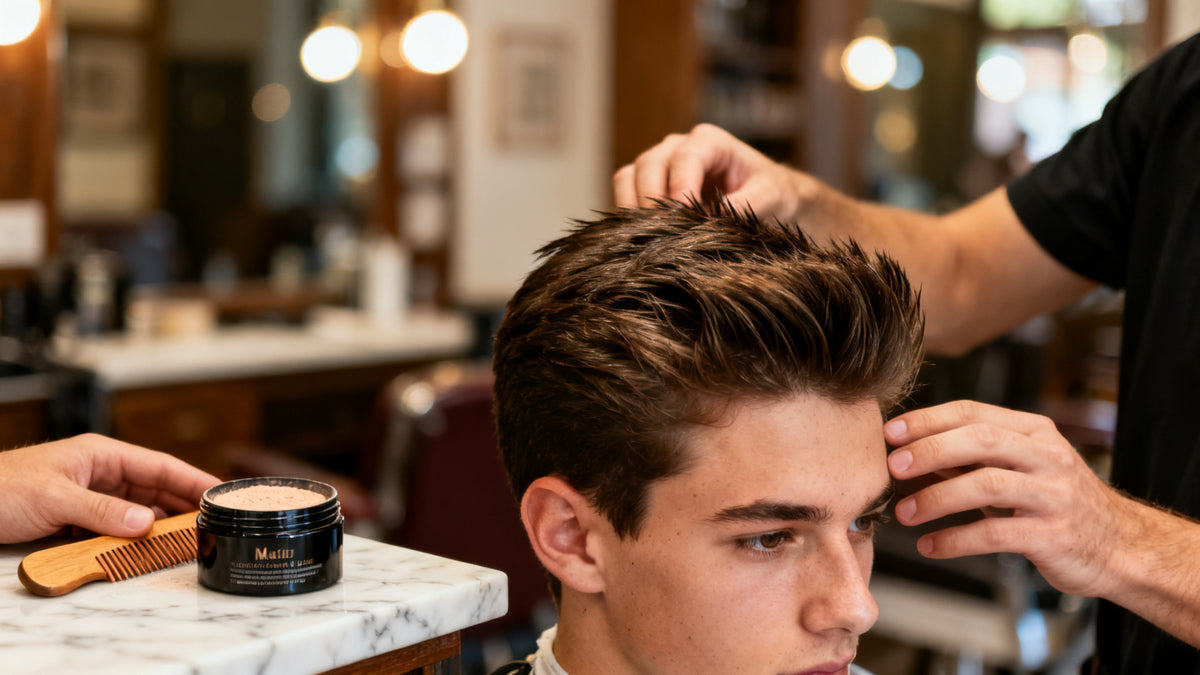
Fine hair is often a matter of millimeters. Improper drying, the wrong product, and your hairstyle is flat before you've even left the house. Yet, simulating greater hair density doesn't require a miracle. A few routine adjustments make all the difference. Cut, drying, product, order of application... everything counts, and none of it is rocket science.
⭐ Key Takeaways
- The cut is the first variable to work on: it structures everything else.
- Proper drying can add as much volume as a good product.
- Heavy products (gels, greasy waxes) weigh down fine hair: avoid them at all costs.
- Texturizing powder and sea salt spray are the two most effective allies for this type of hair.
- The order of product application changes the final result completely.
Why does fine hair go flat so quickly?
A fine hair measures less than 60 microns in diameter: it does not support the weight of products and moisture well, which explains the rapid collapse at the roots. This is not inevitable, it is a mechanical constraint. Understanding this changes the way we choose everything: shampoo, styling product, drying technique.
The fine hair also carries less mass. When a product that is too heavy settles on it, it sticks the strands together and creates the opposite effect of the one desired. Result: less apparent volume, more greasy shine, and a hairstyle that collapses after two hours.
Another point often forgotten: the scalp plays a direct role in perceived density. An irritated or clogged scalp slows down growth and reduces root hold. Cleaning regularly with a light shampoo and rinsing well with cold water (to close the cuticles) are two simple habits that improve the visual result from the first few weeks. Dermatologist Hélène Aubert, a scalp specialist, reminds us that "the follicular environment conditions the quality of the hair as much as its genetics": taking care of the base means taking care of volume.
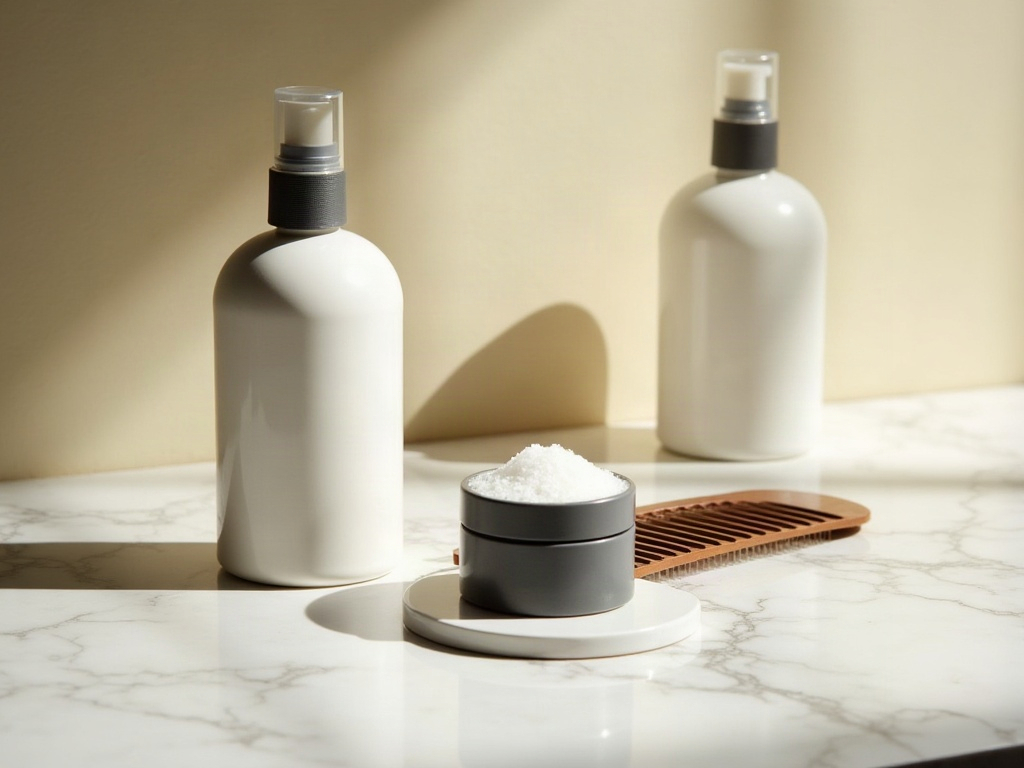
The cut: the real foundation of volume
Before any product, the cut determines 60 to 70% of the visible volume on fine hair. A suitable cut creates the illusion of denser hair without any product. This is not a hairdresser cliché: it is hair geometry.
The cuts that work for fine hair
Short tapered cuts on the sides with volume on top (type undercut or fade) are often cited, but they are not the only options. The basic principle: concentrate the mass in one place rather than diluting it over the whole head.
- The high taper: very short sides make the top look fuller by contrast.
- The unstructured textured cut: the hairdresser works the ends in spikes to create movement and break the "stuck-together hair" effect.
- Medium length (5 to 8 cm on top): long enough to create volume, not long enough to weigh down the roots.
- Very long and uniform cuts: they accentuate the fineness and weigh down the roots.
A good hairdresser who knows fine hair will also work on thinning from the bottom (thinning out) rather than from the middle. This preserves the visual thickness on the surface while lightening the overall weight.
The frequency of cuts
Fine hair benefits from frequent cuts: about every 5 to 6 weeks. Damaged or split ends create a "thin hair" effect that visually goes down to the root. A fresh cut, even a light one, gives sharpness back to the hair silhouette.
💡 Did you know?
The average diameter of a human hair varies between 50 and 100 microns. A "fine" hair is below 60 microns: that is less than the thickness of a standard sheet of paper. This minimal difference radically changes the way the hair reacts to moisture, weight, and styling products.
Drying: the step almost everyone rushes
Drying is the most underestimated step to give volume to fine hair. A well-mastered technique creates volume at the root that lasts for several hours, without any additional product. No need for a professional tool, just a precise order.
Dry the roots first, the ends last
The majority of men dry their hair by running the hair dryer from top to bottom or by rubbing with a towel. These two habits crush the roots. The right approach:
- Tilt the head forward, hair down.
- Direct the airflow at the root, lifting the strands with the fingers.
- Lift the head when the roots are 80% dry, then finish the lengths.
- Finish with a blast of cool air (10 seconds) to set the created volume.
This technique exploits the mobility of the still damp roots. Once the hair is dry, its shape is frozen: if you dry it flat, it will stay flat. It is as simple as that.
The microfiber towel: a detail that counts
Cotton towels rub the hair cuticles and create frizz on fine hair. A microfiber towel, or simply a soft cotton t-shirt, absorbs water without aggression. The result: more defined strands and a root that stays lifted longer.
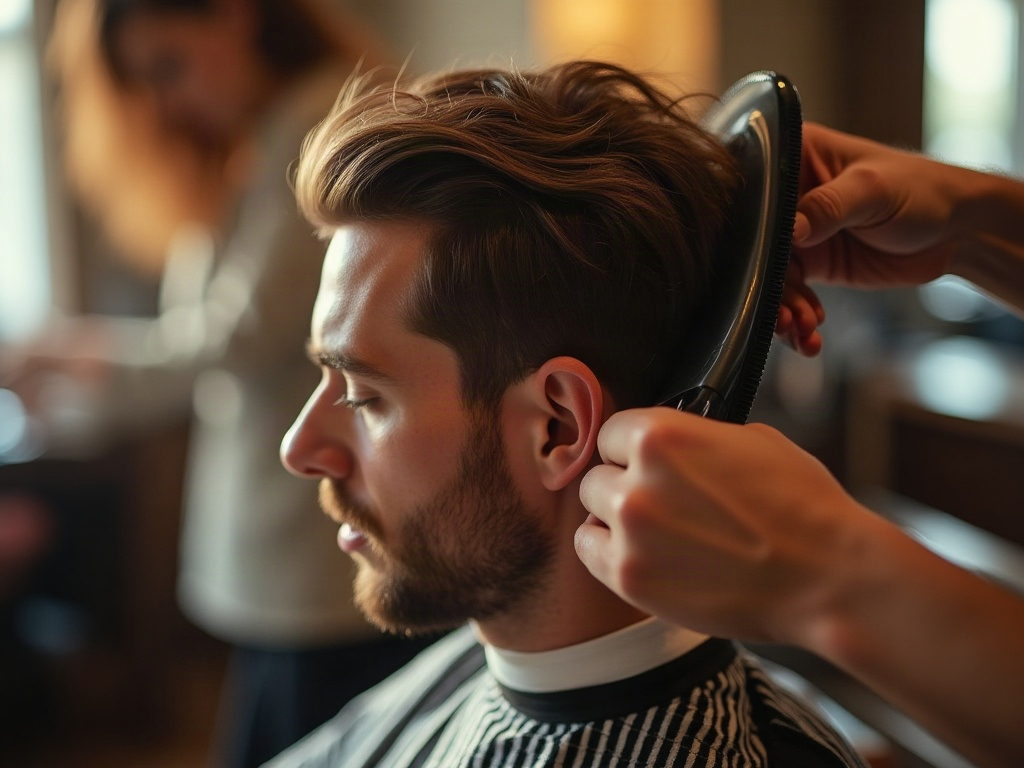
Choosing the right product: the fine hair rule
For fine hair, the rule is simple: favor a light product with a flexible hold, which texturizes without sticking. High-hold gels, greasy waxes, and hair oils are to be set aside for this type of hair, without exception.
Products to favor
| Product type | Effect on fine hair | Verdict |
|---|---|---|
| Texturizing powder | Immediate volume at the root, natural matte effect | ✅ Best ally |
| Sea salt spray | Texture, lightness, "after beach" effect | ✅ Very effective |
| Light matte wax | Flexible hold, natural finish | ✅ Usable in small quantities |
| High-hold gel | Sticks the strands together, accentuates fineness | ❌ Avoid |
| Greasy / shiny wax | Added weight, stuck-together hair effect | ❌ Avoid |
| Hair oil | Weighs down, makes flat and shiny | ❌ Avoid |
The order of application that changes everything
Many apply their product on dry hair, which reduces diffusion and creates sticky areas. Here is the right order to maximize volume on fine hair:
- Sea salt spray on still slightly damp hair (after drying to 80%).
- Final drying with fingers or the texturizing comb.
- Texturizing powder on dry roots: a few pinches are enough, rub between palms then slide at the root.
- A touch of light matte wax on the ends only, if you want to define the contour.
This order exploits each product at its optimal moment. The spray structures during drying, the powder fixes volume at the root, the wax refines without crushing.

Sea salt spray: why it is so effective on fine hair
Sea salt spray brings texture without any weight: mineral salts swell the cuticle and create natural volume with a matte finish. It is one of the few styling products whose action is purely mechanical, without residue or accumulation over the days.
The trick comes from the way the salts interact with keratin: they slightly open the hair cuticle, which gives the hair more perceived thickness and more hold between the strands. On fine hair, this effect is particularly visible because the cuticle is naturally smoother and less textured.
For fine hair, using the spray on slightly damp hair (not wet, not dry) is the best window. Apply it at a distance of 20 cm, spraying over the entire length. Gently rub at the root, then finish with the hair dryer or let dry to the air depending on the desired result.

The daily habits that maintain volume
Beyond products, a few regular habits maintain natural volume in fine hair. Without any special effort and without buying anything extra, these simple steps make a measurable difference week after week.
Scalp massage
Massaging the scalp for 2 to 3 minutes every morning (in the shower or on dry hair) stimulates blood circulation around the follicles. Better-irrigated follicles produce stronger hair strands over time. This is not a promise of miraculous regrowth: it is basic maintenance that optimizes what you already have.
The technique: use the pads of your fingers, never your nails, with small circular movements covering the entire surface of the scalp. 2 minutes is more than enough.
Washing frequency
Fine hair visually accumulates sebum faster because the thin oily layer coating each strand is proportionally more visible. Washing every two days with a light shampoo (without harsh sulfates) is often the ideal balance. Washing too often dries out the scalp and causes an overproduction of sebum in response.
Diet: a real factor
Hair is made of approximately 95% keratin, a protein. Insufficient intake of protein, zinc, and B vitamins (especially B7) weakens the hair strand. Eggs, legumes, nuts, and fatty fish are the most accessible food sources to support hair health. No miracles here either: but it is a foundation that many hair routines completely forget.
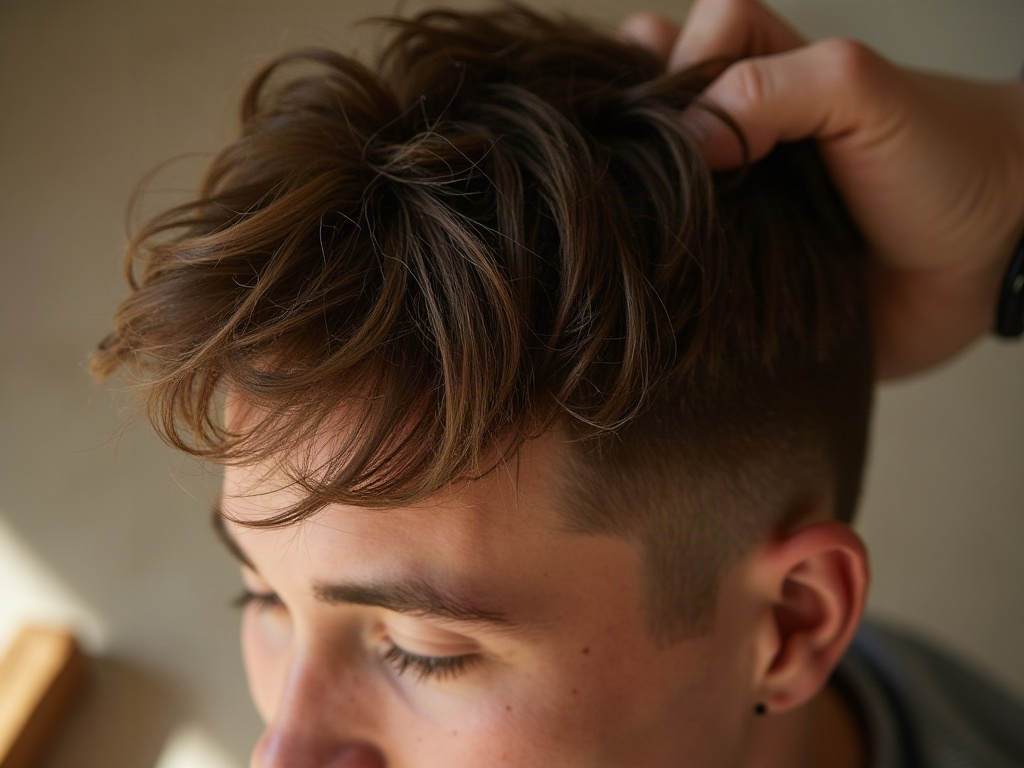
The texturizing comb: an often underestimated tool
A wide-tooth comb lifts the roots, creates light waves, and distributes the product without clumping the strands. It is a simple tool that doubles the effect of products and costs less than fifteen euros. Yet, most men ignore it.
The classic mistake: using a flat brush or a fine-tooth comb on fine hair. These tools smooth and flatten. A wide-tooth or spaced-tooth comb, used against the grain (from bottom to top) at the root, creates exactly the desired volume.
The texturizing comb also has a discreet advantage: it allows you to work the hairstyle after drying without undoing the volume already created. A few light passes over the top of the head and the hairstyle regains height in 15 seconds. Useful in the middle of the day when the volume has collapsed.

What "thickening" products really do to the hair fiber
Thickening hair means depositing a layer of active molecules on the strand that increases its apparent diameter. Some shampoos and treatments contain polymers or hydrolyzed proteins that do exactly this work, wash after wash.
The result is temporary: it lasts until the next wash. But on fine hair, this strand swelling effect can radically change the perceived volume, especially at the root. Volumizing shampoos often contain biotin, silk proteins, or panthenol (provitamin B5) for this effect.
One thing to watch out for: "thickening" products that promise accelerated regrowth make promises they cannot keep. What these products actually do: they optimize the surface condition of the existing hair. That is already a lot, provided you do not expect a miracle.
"Volume is 30% product and 70% technique."
Heard in the best Parisian barbershops
This ratio is debatable depending on the hair, but it illustrates the hierarchy well: mastering drying and technique takes precedence over the choice of product. Good technique with a modest product often gives better results than a premium product poorly applied. Technique, always first.
Avoiding the straw effect: hair care mistakes that weaken fine hair
The straw effect on fine hair almost always comes from an excess of heat or harsh chemicals. These two factors damage the hair cuticle and deprive the hair of its natural hydration, making each strand more fragile and less voluminous.
Sources of excessive heat
Hair dryers at full power, flat irons, and repeated curling damage the keratin. On fine hair, which is already less dense, the impact is more visible. Using the hair dryer on medium heat (not the "max" setting), at least 15 cm from the scalp, preserves the hair structure while creating volume.
A heat protectant spray (without silicone) can be useful if you use heat tools regularly. The goal is not to eliminate heat but to control it.
Products to avoid to preserve the fiber
- Shampoos with harsh sulfates (sodium lauryl sulfate in particular): they cleanse too aggressively and alter the scalp's hydrolipidic film.
- Hair masks that are too rich applied to the roots: they weigh hair down and cause the "flat hair right after the shower" effect.
- Styling products with denatured alcohol at the top of the ingredients list: they dry out the hair strand over time.
⚠️ Warning
"Clarifying" or "detox" shampoos formulated for oily hair are often too harsh for fine hair. They cleanse effectively but strip the roots and cause progressive weakening of the strand. It is better to stick to a gentle formula, even if the hair seems oily quickly.
FAQ
How to naturally thicken fine hair in men?+
Work the cut (high fade, textured cut), master drying (roots first, head tilted forward), use light products like texturizing powder or sea salt spray, and regularly massage the scalp. These four combined approaches give the most visible results without chemical treatment.
How long before seeing results?+
Results on visible volume (drying, products) are immediate from the first try. Underlying improvements, such as a more resistant root or a stronger hair strand thanks to massages and better nutrition, are visible in 4 to 8 weeks. A fresh cut, on the other hand, transforms the silhouette the day after the salon.
What does it mean to thicken hair?+
Thickening hair means temporarily increasing the apparent diameter of the hair strand thanks to products containing hydrolyzed proteins, panthenol, or film-forming polymers. These molecules deposit on the hair cuticle and create a visible swelling effect. The effect lasts until the next wash.
How to avoid the straw effect on fine hair?+
Reduce exposure to excessive heat (hair dryer on medium heat, flat irons used in moderation), avoid shampoos with harsh sulfates, do not apply rich masks to the roots. Favor styling products without denatured alcohol at the top of the ingredients list.
Is it a good idea to thin out your hair when you have fine hair?+
It depends on the technique. Thinning from the bottom (pointed) lightens the overall weight while preserving the visual thickness on the surface: it is suitable for fine hair. On the other hand, thinning from the middle of the strand reduces visible density and accentuates fineness. Always specify to your hairdresser that you have fine hair before they start working on the texture.
Which styling powder to choose for fine men's hair?+
Choose a powder with an ultra-light formula, a matte finish (never shiny), and without heavy waxes. It must be applied in small quantities directly to the root and create volume without clumping the strands. The Barbary styling powder meets exactly these criteria: light, matte, immediate volume.


