

Hair that lies flat from the morning: it's not inevitable. Behind flat, volume-less hair there are almost always specific causes, biological or related to your routine, that can be corrected without revolutionizing everything.
This guide reviews every serious reason, with the steps that really make a difference. No empty promises: clear answers.
⭐ Key takeaways
- Excess sebum is the leading cause of flat hair, often before the cut or product.
- Overly rich treatments weigh down the fiber: even a "light" conditioner can be enough to flatten everything.
- Improperly regulated heat breaks the hair's internal structure and makes it lose its natural bounce.
- A poorly chosen or applied volumizing product has the opposite effect.
- The cut plays a role, but it cannot make up for a bad routine.
What really happens in the hair fiber when hair lacks volume
Flat hair is not "weak" hair: it is hair whose hair shaft is too smooth, too weighed down, or too thin to stand up against gravity. The diameter of the fiber, its internal keratin, and its hydration level all determine its ability to "hold". When one of these parameters fails, volume collapses.
Keratin forms the hair's framework. It is structured in helices, like a microscopic spring. When this framework is damaged by heat or chemical treatments, the spring loses its tension. Result: the strand remains flat even after styling.
The diameter of the fiber decreases with age
Past 25-30 years, the diameter of each hair fiber gradually reduces. A thinner hair weighs less but also resists gravity less, which explains why many people notice a loss of volume over the long term without actual hair loss. It is not baldness: it is a silent miniaturization of the fiber.
This evolution is normal. It is managed with the right products, not with intensive treatments that, in turn, worsen the problem.
Why sebum is the leading cause of flat hair
The sebum produced by the scalp accumulates at the root and mechanically sticks the hair against the scalp, eliminating all volume at the base. This is the most frequent and least visible cause because it is rarely associated with "oily" skin: even a normal scalp produces enough sebum to flatten volume in 24 hours.
The problem is amplified when you wash your hair too often. Each aggressive shampoo stimulates the sebaceous glands to produce more, through a compensatory mechanism. We enter a vicious cycle: the more we wash, the faster the sebum returns, the faster the hair falls flat.
The daily shampoo mistake
Washing your hair every day with an ordinary shampoo strips the protective lipid film. The scalp reacts by overproducing sebum in the hours that follow. Spacing out shampoos to 2-3 times a week significantly reduces sebum after a month of regular practice.
While waiting for the scalp to adapt, a dry shampoo applied to the roots absorbs residual sebum and recreates volume without water. It is a transitional step, not a permanent routine.
💡 Did you know?
The sebaceous glands of the scalp are among the most active in the entire body. On a scalp with high sebum production, they can produce several milligrams of sebum per square centimeter per day (according to measurements published in dermatology), enough to stick entire strands to the root before noon.
Overly rich treatments that weigh down the fiber
A classic conditioner, an "intense nutrition" mask, or an oil applied to the entire length deposits an occlusive film on each hair, multiplies its apparent weight, and eliminates all hold at the root. This is the most frequent cause for people who have fine hair and "do everything right anyway".
The paradox is real: fine hair often has a dry scalp, so we pamper it with rich treatments. But these treatments are formulated for thick and porous hair. Applied to a fine fiber, they cover it with a greasy layer that it does not absorb. The hair does not benefit from any additional nutrition and simply ends up weighed down.
How to identify a treatment that is too heavy for your fiber
The test is simple. After washing and drying, run your hand through your hair. If you feel a slight sticky or oily residue, even subtle, the treatment is too rich. A suitable treatment leaves the fiber clean, light, without any perceptible residue to the touch.
Look for formulas labeled "silicone-free" or "volumizing". Silicones (dimethicone, cyclopentasiloxane) accumulate on the fiber over successive washes and create exactly this invisible weight effect.
The impact of drying and heat on volume
Drying your hair with your head tilted down, then letting it fall naturally, is one of the most effective techniques for creating volume at the root without any product. Conversely, drying vertically while letting the strands fall in their natural direction "folds" the root against the scalp while it is still wet, and it dries that way.
Heat plays a double role. When properly regulated, it can amplify volume. When improperly regulated, it breaks the internal bonds of the fiber (what we call keratin bonds, in other words, the hair's microscopic spring) and creates split ends that make the fiber rough, heavy, and without bounce.
The right temperature, depending on the fiber
| Fiber type | Recommended temperature | Risk if exceeded |
|---|---|---|
| Fine and fragile | 150-160 °C max | Loss of bounce, breakage |
| Normal | 160-180 °C | Gradual drying out |
| Thick and resistant | 180-200 °C | Cuticle burn |
| Curly and coily | 150-170 °C | Permanent loss of curl |
For fine hair, using the hair dryer on the warm setting (not hot) at a distance of 20 cm is sufficient. Hot air at close range cooks the fiber without giving it any additional hold.
Styling products that flatten instead of lifting
A classic gel, styling cream, or overly heavy wax deposits weight on each strand, which is exactly the opposite of what flat, volume-less hair needs. Many people try styling products, see no results or see their hair even more plastered together, and conclude that "products don't work for them". In reality, it is the wrong formulas.
For fine hair, the rule is simple: favor dry and light textures. A volumizing styling powder, a sea salt spray, or a root lift is often enough. These formats add friction between the strands and prevent them from sliding against each other, which creates the illusion of density.
How and when to apply a volumizing product
Timing changes everything. Applying the product to slightly damp hair gives significantly better hold than applying it to completely dry hair. Residual moisture helps the product adhere to the cuticle and hold during drying.
For styling powder, apply directly to the roots, in small touches, massaging lightly. No need to use much: a pinch is enough for one area, otherwise the "dusty hair" effect appears.

The cut: its true role (and its real limits)
A cut that is too long or too heavy in length pulls mechanically on the root and prevents volume from forming, even if everything else is perfect. The weight of the lengths is a real physical force: the longer the hair, the more it stretches downward under its own weight.
For fine or flat hair, short cuts at the mid-nape or well-placed layers create a structural lightness that makes volume hold naturally. But beware: a good cut cannot make up for a routine that flattens. It is an amplifier, not a substitute.
The illusion of density through the cut
Trimming the ends slightly every 6 to 8 weeks eliminates split ends that make the hair appear sparse at the ends. Neat ends give a much greater impression of density than lengths that are kept but damaged. It is a detail that many neglect because it seems insignificant, but the visual effect is immediate.
Often ignored biological causes
Some loss of volume does not come from the routine but from the body: iron, zinc, or biotin deficiencies, hormonal imbalances, and chronic stress directly affect the hair fiber from the inside. In these cases, no external product will solve the problem permanently.
Iron deficiency reduces the supply of oxygen to the hair bulb. The bulb then produces a thinner, more fragile fiber, which grows more slowly and falls out earlier. The effect resembles hair loss, but it is mainly a progressive miniaturization.
The signals that indicate an internal cause
- The loss of volume is gradual over several months, not related to a change in routine.
- The hair appears thinner all over the head, not just at the root.
- Persistent fatigue, brittle nails, or dull skin accompany the phenomenon.
- The situation worsens despite a correct and adapted routine.
If several of these signs are present, seeing a doctor for a complete blood test is the most useful course of action. Targeted supplementation can restore density over 3 to 6 months, according to available trichology studies, whereas styling products merely mask the problem.
💡 Did you know?
Prolonged stress can cause diffuse hair loss called telogen effluvium (in plain terms: all the bulbs "fall asleep" at the same time, prematurely, due to cortisol). Hair falls out in large amounts 2 to 3 months after the stressful episode, making the link difficult to identify. The good news: it is completely reversible once the cause is treated.
9 concrete steps to regain lasting volume
Here is a directly applicable checklist, ranked from the simplest to the most structured step, to restore volume to flat hair starting with the next washes.
- Rinse with cold water after shampooing: cold water closes the cuticles and makes the hair shaft smoother and lighter.
- Dry upside down with the hair dryer on a warm setting to lift the roots from the start.
- Only apply conditioner from mid-length down, never on the roots or scalp.
- Switch to a shampoo formulated for "volume" or use a "clarifying" shampoo once a week to remove product residue.
- Apply a texturizing powder to the roots on slightly damp hair before finishing the drying process.
- Avoid touching your hair once styled: every time you pass your hands through it, you transfer sebum from your palms to the hair fiber.
- Change your haircut if your hair is past your shoulders and fine: a shorter cut immediately releases volume.
- Check for deficiencies if you have been gradually losing volume for more than three months without an obvious routine explanation.
- Use a sea salt spray to add texture and create friction between the strands, instead of a gel or cream.

When routine alone is no longer enough: build a real method
Adding isolated steps is not always enough: it is the consistency of the entire routine, from washing to final styling, that makes volume last without falling flat in the middle of the day.
A good clarifying shampoo followed by a conditioner that is too heavy resets all the benefits. Perfect drying followed by the application of a gel-cream crushes the result. The method that works is organized around three steps: properly preparing the hair fiber (appropriate washing, cold rinse, upside-down drying), texturizing with the right products (dry or lightweight formulas, applied at the right time), and maintaining it throughout the day (not touching it, no additional layer of product after styling).
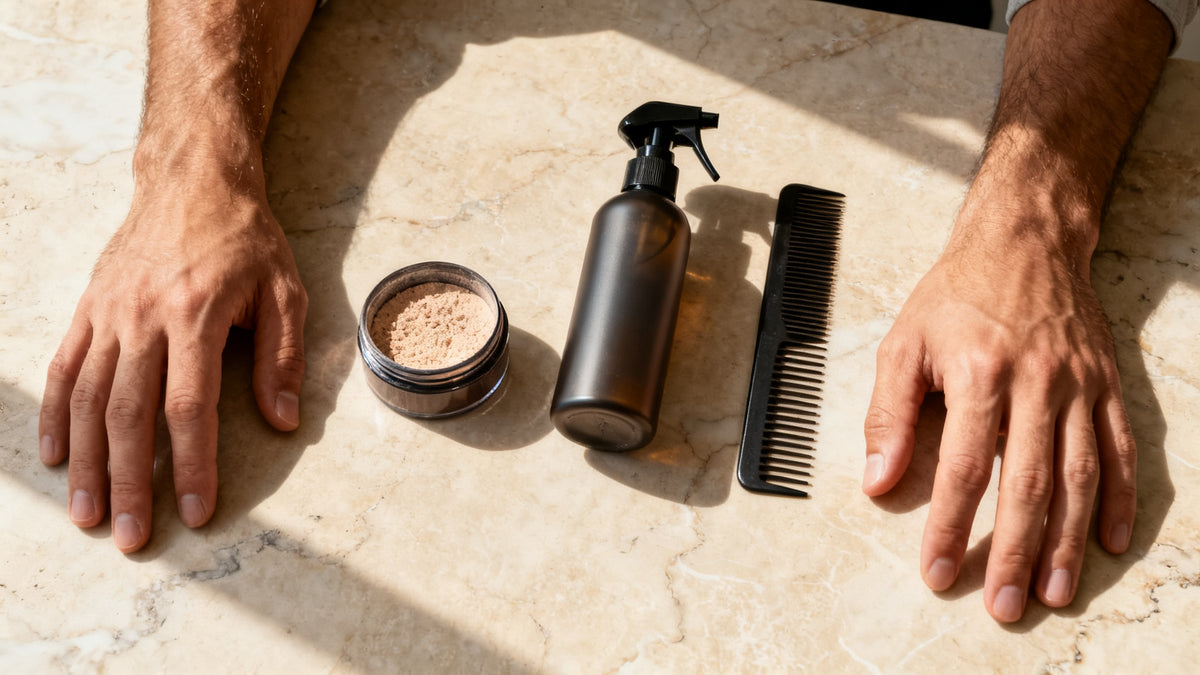
For those starting from scratch, a complete kit avoids selection errors. Volumizing powder, texturizing spray, and a suitable comb cover the three phases of styling without over-investing.

Frequently Asked Questions
Why is my hair thinner than before?+
The diameter of the hair fiber naturally decreases with age, starting in your twenties for some. The most common causes are hormonal (a drop in estrogen or testosterone depending on the profile), an iron or zinc deficiency, or prolonged stress that has disrupted the bulb cycle. A medical check-up allows you to identify the exact cause and act in a targeted way.
How can I regain hair volume?+
The perceived "volume" is a combination of density (number of hairs), fiber diameter, and styling hold. For density and diameter, targeted supplementation (iron, biotin, zinc depending on deficiencies) can help over several months. For hold, a volumizing powder or sea salt spray immediately creates an impression of additional volume by adding friction between the strands.
What deficiency is linked to hair volume loss?+
Iron deficiency is the most common deficiency associated with hair volume and density loss, especially in women. Zinc is involved in the production of keratin (the main protein in hair) and its lack weakens the fiber. Biotin (vitamin B8) contributes to the mechanical resistance of the hair. In any case, self-medication should be avoided: an excess of iron or zinc can be harmful. A precise blood test is the first step.
How can I give my hair less volume (if it has too much)?+
The opposite problem is also managed with products. A smoothing styling cream, a rich conditioner applied to the entire length, or drying flat with the flat side of the brush allows you to tame excessive volume. For a lasting effect, a Brazilian straightening treatment or a professional keratin treatment restructures the fiber over several weeks.
Can flat, volume-less hair improve without cutting?+
Yes, by far. A haircut helps but is not mandatory to regain volume. Changing shampoo, changing the drying technique, switching to dry volumizing products, and spacing out washes are changes that produce visible results in two to three weeks, without touching the length.
Can you regain volume with long hair?+
Yes, even without cutting. For long hair, the priority is to lighten the roots: clarifying shampoo once a week, conditioner only on the ends, and drying upside down. A volumizing spray applied to the roots before drying compensates for the weight of the lengths. Well-placed layers can also remove weight without sacrificing length.


